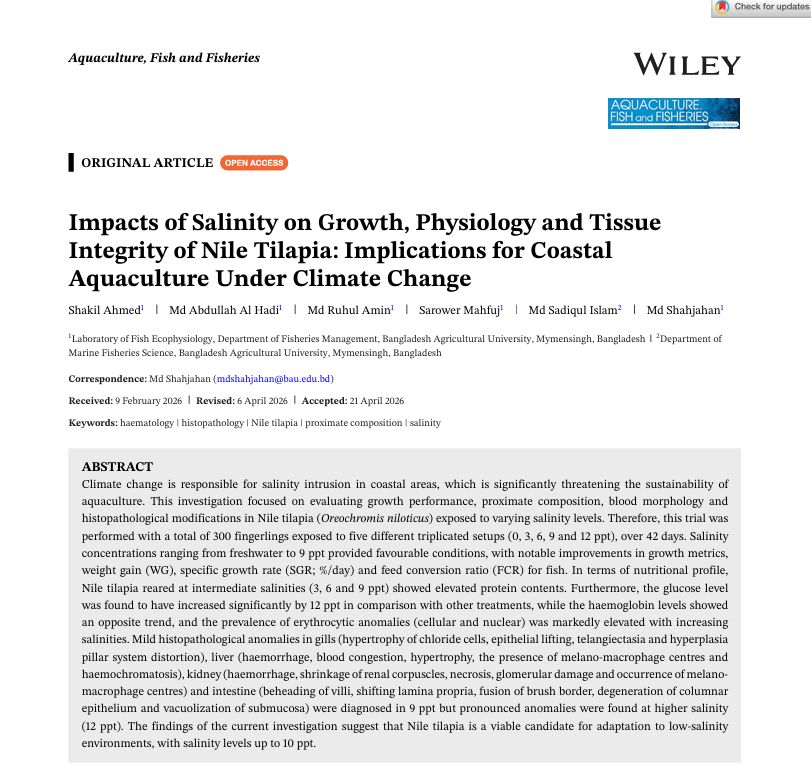
New Nile Tilapia Salinity Research Published in Wiley Journal
We are delighted to announce that our laboratory has achieved its 14th publication of the year. This latest piece of Nile Tilapia salinity research is now available in the prestigious journal Aquaculture, Fish and Fisheries (published by Wiley). The journal is recognized as a Q2 publication with an Impact Factor of 1.9, marking another milestone for our research team.
Climate Change and Coastal Aquaculture
The article, titled “Impacts of Salinity on Growth, Physiology and Tissue Integrity of Nile Tilapia: Implications for Coastal Aquaculture Under Climate Change,” addresses a critical global issue. As sea levels rise due to climate change, salinity intrusion in coastal areas becomes a major threat to food security. This Nile Tilapia salinity research investigates how varying salt levels affect the growth and physiological health of one of the world’s most important food fish.
Key Findings and Research Impact
Our study provides deep insights into the tissue integrity and survival mechanisms of Nile Tilapia. By understanding these physiological changes, researchers and fish farmers can better prepare for the challenges of coastal aquaculture. The findings of this Nile Tilapia salinity research offer practical implications for maintaining fish production in changing environmental conditions.
Congratulations to the Research Team
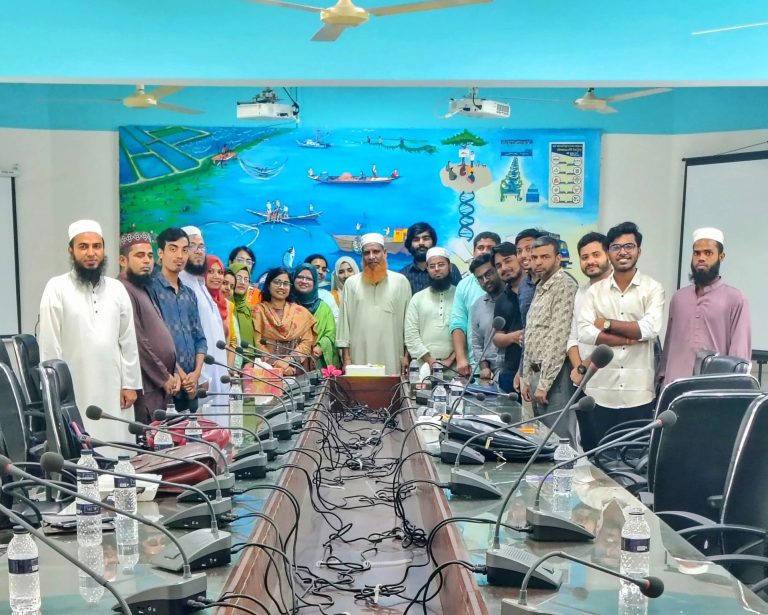
We extend our heartfelt congratulations to all the authors for this significant accomplishment. A research output of this caliber requires immense dedication and precision. We also express our sincere gratitude to Professor Dr. Md Shahjahan for his invaluable supervision. His continuous support and inspiring guidance remain the backbone of the Laboratory of Fish Ecophysiology.
Under his leadership, our lab continues to produce high-impact Nile Tilapia salinity research that contributes to the sustainable development of the blue economy. We look forward to more breakthroughs that bridge the gap between laboratory science and field-level aquaculture solutions.
Access the full article here: Full Research Paper